
Two referenda?
Two referenda? Aye, right
Our Liberal 'Democrat' Secretary of not-very-much, Michael Moore (no, not the famous Michael Moore, the other one) thinks we need two referenda to achieve independence. What has he been smoking?
The theory of it starts here: the Westminster parliament, in its Scotland Act, did not cede to the Holyrood parliament the power to hold legally binding referenda. So, says Moore, a referendum held by the Holyrood parliament cannot be legally binding. So, says Moore, we need a subsequent referendum, promoted by the Westminster parliament, to complete the process.
On living rough with cats
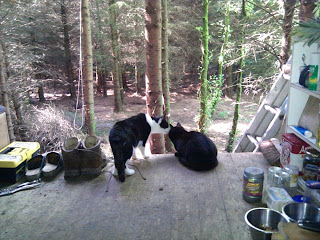
We're all familiar with the image of an urban rough sleeper with his mongrel on a string. Rough sleepers commonly have dogs, and it's easy to understand why. A familiar animal — an animal which offers some affection, some uncritical regard, and, at night, some warmth — has to help a person cope with the extremely tough life a rough sleeper has to cope with.
But you don't typically see rough sleepers with cats. Cats are different from dogs; they are much more self sufficient: specialist individual predators, able to feed themselves adequately in most British landscapes. A closely related species is even native. Cats don't, in fact, need us. When they choose to live with us it's from choice. That choice is certainly based on some simple pragmatic considerations. If we have the resources we can provide regular palatable food. If we have homes, we can provide comfort and warmth — which cats love — and a degree of security. We also, if we have homes, provide stability of place — a fixed base, a hub for a hunting ground. Cats do like a familiar hunting ground.
Well, we're no longer in the Summer Palace. Of our twenty days there, it rained on nineteen and blew a gale on five. Last night, the BBC was forecasting gusts of 82 miles per hour — literally hurricane force.
By dawn it was obvious that I couldn't really depend on the roof surviving; even if it did, sheeting rain was falling and fine spray was blowing through the Summer Palace, making everything wet. The shipping forecast was more soberly predicting force ten, and the BBC's 6am domestic forecast had dropped it's prediction to only 70 mph. If I'd just been myself I'd probably have tried to hold out, but the idea of trying to catch the cats after the roof had gone didn't appeal, and I decided to abandon ship while I could. I started to make things as secure as I could.
Neadless to say I didn't have the cat's transport box down at the summer palace. Ivan, who'd slept cuddled in with me all night, was still under the downie, so I emptied the cooking box and unceremoniously bundled him into it. I wheelbarrowed him over the hill to the farm; at the top I could barely stand.
The Summer Palace
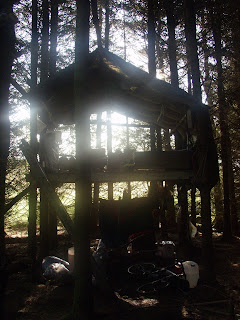
Tonight is our third night in the summer palace. The experience is throwing up problems I didn't expect, as well as ones I did. I have an urgent need to find somewhere for a midden for food waste — far enough away that it doesn't attract rats to the summer palace (although the cats would deal with them), near enough that it's practical to use.
Clothes don't dry in the wood — there isn't enough air movement and there isn't enough sunlight. So I'm going to have to put a clothesline out in the meadow somewhere. That also has implications for my living economy: if clothes do not dry, I must be very careful about getting wet. Fortunately, I haven't yet had a problem with rain blowing into the palace — despite two very wet windy nights; so I think I'm probably OK there.
Going straight
The singlespace roof has a slight twist, and I love it. The inner triangle is three and three quarter degrees off square from the middle hexagon, which again is three and three quarter degrees off square from the outer ring. It's that subtle twist that makes the roof so uneuropean, so quirky.
There's a reason, of course. The reason is that I couldn't get rafters long enough to span the ten metre diameter internal space that I wanted; and I didn't want to have to make a very complex joint at the top of each pillar. But I've been spending the last week working very hard on working out how to make my dwelling simpler to build, lower carbon and, ideally, cheaper; and one of the questions I've asked myself is how big a single space could I build with the rafters I can get.
The answer is that I can get 4800mm rafters at 200 x 50mm cheaply — just as cheap per metre run as 3600mm rafters. Given that the rafters cannot go right to the peak of the roof and that the gradient is shallow, two 4800mm rafters will actually span almost ten metres. But that's the full span of the roof. The walls come inside that span. If I'm going to use straw bale — which I'm now thinking of very seriously — each wall is 600mm thick, and allowing 150mm for eaves that takes 1500mm — or 15% — off the inner diameter, and consequently off the floor space; down from 78.5 square metres to 56.75 square metres.